skip to main |
skip to sidebar
dir. Gillo Pontecorvo

Sir William Walker can out-puppet Don Corleone any day of the week.
Jeff GP, NEW YORK CITY
February 12, 2007 - 35mm/Film Forum
Not unlike Italian director Gillo Pontecorvo’s previous feature, The Battle of Algiers, Burn! is a sprawling, rambling, geographically contained epic of timeless urgency. The lesson is a simple one. No person can free another person; a person can only free themself. The method by which this lesson is taught is the interesting thing here. An unusually and appropriately restrained Marlon Brando plays an Englishman with flowing locks of hair. This hair, along with his collected demeanor first suggests the classic “white man out to save the black people” narrative, though Mr. Brando turns out to be the classic “wolf in sheep’s clothing.”
He lands on a Portuguese Caribbean colony where, naturally, Africans have been enslaved to work sugar plantations. After witnessing a government endorsed beheading of a “friend,” our white knight helps the deceased’s family carry the beheaded body back to their home. He then proceeds to hang around looking for the smallest indication of rebellion amongst the enslaved. Once he discovers this, in the form of Jose Dolores (Evaristo Marquez), a band of revolutionaries is formed and Brando leads his pupils by the hand through a successful revolution. This first portion of the movie is riveting political thriller/revolutionary cinema stuff, and it all carries the impressive weight of a “why dunnit?” rather than a “who dunnit?” Why is Brando’s Sir William Walker doing this? Is it out of hate of the Portuguese? Has he been hired to free the people for their own good? Yeah, right. Sir William is on that island for the same reason any imperialist country has any presence in any “unstable” country. Money.
Abruptly Sir William convinces Jose that he is unfit to actually run an organized government and installs a puppet ruler. Britain wins! 10 years pass; talk about abrupt, a title card just flashes on screen. Brando no longer holds any interest in the island he fought so hard for. It was all in a day’s work, and now he is enlisted by his government for another day’s work, this time fighting against the still wound up and enslaved islanders and their still powerful leader, Jose Dolores. The second half of the movie is far more ambiguous and difficult to comprehend than the first, due to the fact so much time has passed and that Britain and therefore Sir Williams Walker’s interests are in stark opposition to their previous allies. This is a historical norm with imperialist governments, and it has never been so pointedly represented.
Brando’s character, through the first half of the picture, is presented as a morally ambiguous presence, but this ambiguity is exposed as heartless and inhumane, no matter if his actions seem well intentioned in the first portion. No matter if this imperialist nation is fighting for “good” or “evil” they are still “evil,” but more than evil, greedy. Brando plagues this island like a curse, and this time around the violence takes on a far more affecting strain in the form of civil war. The island is divided between those who decided to follow the puppet leader, and thus Dolores’ troops now war, not against English or Portuguese soldiers, but against their own people. Brando simply observes, a political puppet master with only the slightest twang of guilt over the chaos he caused at the behest of his nation.
Sir William Walker is a fascinating, complex creature and Brando plays it all with maniacal detachment in his eyes. Struggling to figure him out, Jose becomes the audience’s eyes and ears, which adds to the complexity of the movie’s structure, considering Jose is not the main character. Sir William is our hero, and it is often a horror to be left alone with him. Ennio Morricone adds a gripping musical theme of epic heroism with an underlying current of menace, as the camerawork acts similarly, shaking through a chaotic mass of extras, yielding a grand scope of intimacy and uncertainty. The uncertainty yields passages that are uneven and less interesting than others, but Burn! remains one of the most politically complex movies I’ve seen, even if the morals of the story are beat over your head in the final moments.
 "Buster, if they click the title above our picture, they can watch the entire movie."
"Don't make me laugh, Beckett."
Jeff Larson, NEW YORK CITYFebruary 5th, 2007 - World Wide Web
In Samuel Beckett’s Endgame -- Cormac McCarthy fans take note: this is the precursor to The Road -- a character says to the others, “Use your head, can’t you, use your head, you’re on earth, there’s no cure for that!” And what a delightfully accurate summary of Beckett’s works it is. Samuel Beckett: the bromide solipsist, the shit satirist, the despair humorist, the maximum minimalist. The ultimate modernist.
Beckett’s works approach life as a purgatorio, as a tedious affair of rotting flesh, locked limbs, and failing bodily functions punctuated by flatulence and discomfort. For Beckett, death merely is an inconvenience, a release to undergo at the end of life, and while watching it draw near, his characters indulge in complex algorithms to stave off boredom with the hope that this sweet release will seem to arrive that much sooner. Yet, Beckett’s talent for conveying comedy darkly removes us from the tedium of their realities. In his novel Malloy, the titular character, who is starving and suffering from an increased inability to use his legs, focuses on sixteen “sucking stones” which he found at the seashore -- this will be long, but here we go:
I distributed them equally among my four pockets, and sucked them turn and turn about. This raised a problem which I first solved in the following way. I had say sixteen stones, four in each of my four pockets these being the two pockets of my trousers and the two pockets of my greatcoat. Taking a stone from the right pocket of my greatcoat, and putting it in my mouth, I replaced it in the right pocket of my greatcoat by a stone from the right pocket of my trousers, which I replaced by a stone from the left pocket of my trousers, which I replaced by a stone form the left pocket of my greatcoat, which I replaced by the stone which was in my mouth, as soon as I had finished sucking it.
…
But this solution did not satisfy me fully. For it did not escape me that, by an extraordinary hazard, the four stones circulating thus might always be the same four.
And repeat ad infinitum: Malloy will, of course, go on. The world, for Beckett, contains only these most simple and devastating minutiae of humanity, completely unlike the overwhelmingly beautiful and complex stream of consciousness found in Joyce or Faulkner. This excerpt occurs 40 pages into an 80-page single paragraph which describes Malloy’s increasing inability to survive and his reluctance to do so, and by the end of his journey, he is reduced to slowly crawling forward at less than 14 yards a day. But even in the most tedious of passages, a hint of darkly tainted hilarity bleeds through the futility and insignificance of Malloy’s persistence. Beckett’s novels exclude such pedestrian foofaraws as plot, arc, and often, traditional treatments of character: in Beckett, the characters are always less than human. Whether they are suffering from failing limbs, going blind, or slowly suffocating, these figures often seem to embody mere faint shadows or whispers of the wind. And yet, paradoxically, it is precisely these shortcomings that produce characters who so profoundly and uniquely display existence, and synchronously, all its failings. This singular combinational talent largely accounts for Beckett’s reputation as an extreme bore – Waiting for Godot was once summed up as a play where, “Nothing happens. Twice.” – and, in contrast, a practically knighted champion of literary experimentation.
Beckett, an Irishman and secretary to James Joyce, spent most of his life in France. His sole journey to the States was to enlist Buster Keaton to star in a short film he had written. (Charlie Chaplin, who echoes throughout Beckett’s works – it seems everyone wears a bowler, was his first choice.) In what would be Keaton’s last silent movie, Film opens with an overused, undergraduate shot of Buster Keaton’s eye opening and closing, and unfortunately, the duration of Film feels decidedly French (in the stereotypical sense e.g. self-referential, pandering etc.). However, since his novels and plays were often first published in French before English, his influence on French film – including its preoccupations, and hang-ups -- is deep: Godard reportedly even wanted to film an adaptation of Waiting for Godot, but Beckett balked. Later, we see Buster, 60 years old, nimbly running -- over piles of bricks and construction debris -- alongside a lower eastside New York wall, and nearly tackling a couple standing in his path. This disgusted couple then notices the camera – or, perhaps, Keaton’s pursuer -- and is shocked and dismayed. References of this sort are on par for Beckett, yet often we are to treat them as simple, yet devastatingly dire, jokes: in Endgame, a character, while searching for a living soul outside of his shack after an apocalypse, exclaims, upon turning towards the audience, “I see…. a multitude….in transports …. of joy. […] Well? Don’t we laugh?”
After a scene in which an elderly lady carrying flowers looks at the camera and dies, Keaton rushes into a bare room which contains a cat, a parakeet, a fish, and a dog – plus a mirror, a window, a photo of a statue, and a rocking chair. Over the course of the rest of Film, Keaton will cover up – with the multiple coats that he is wearing – destroy, or remove from the room each of these objects. All the while the camera floats, lazily behind his back and only at the very end do we see Keaton’s face. His goal, we soon realize, is to cease being perceived, for, here, being perceived is to exist. “What a folly! What a boring metaphor for film!” I hear you say. But, there is magic here, if only for the briefest of moments. Keaton is in his element: he has a profoundly difficult time removing the cat and dog -- whenever he throws one out of the room, the other runs back in – and when his coat falls to the floor, he dives to the ground a little too forcefully. And all we can do is laugh, for what a foolish endeavor it is to try to cease to exist and to try this hard. Unlike in Keaton’s other silent films, in this desolate place there is no one left to save, no goal to accomplish. Of course, his project fails, the camera can see him, we can see him, and it turns out he can see himself (in a twist, finally, Keaton observes his pursuer, who is not the camera, but himself).
Film is a spectacular failure, mostly because of its incessant pandering to the theory crowd; it ends with the shot of the eye from the opening sequence, for Christ’s sake. Yet, the dog and cat episode, the sickness-inducing camera movements, and Keaton’s efforts not to be seen are deliciously fun. We celebrate his refusal to live in the present tense, to take place in the here and now, because of his dedication to the cause. And because such blind dedication strikes the rest of us as foolish, the results, through Keaton’s anarchic grace, tremble a tinge of delight and sympathy deep within us. In short, these are complicated and contradictory themes being expressed here, both Keaton’s determined perseverance and his utter failure to accomplish any sort of sane outcome display an exhausting plea for human reality, however fantastic its manifestation may be.
Within this portrayal, Keaton’s determination not to exist contains a distinct odor of heroism – in the classic, and fantastic, sense. This sort of Heroism-through-dedication has its roots everywhere from Odysseus to Hamlet to John Wayne’s Ethan Edwards in The Searchers. All are spectacular failures: Odysseus fails to return to his wrecked home for 19 years while cavorting with a sea nymph, Hamlet pines for the majority of the play only to kill his family and friends, and Ethan Edwards spends 5 years searching for his nemesis only to have the film’s fool find him. And so it is with Keaton, but no one is around to help this hapless hero. His doomed project is merely his own.
(For a more modern, and more successful, take on the themes expressed in Film, check out Matt Larson, directed and shot by the Shuffle’s own Kalen Egan. The similarity between them both is coincidental: we had no knowledge of Film when we made Matt Larson. For all of you out there who insist that the coincidence is too significant, and that we must have been aping, and conversing with, Film: why don’t you just take your salt-and-pepper beards and sweater vests and shove off?)
dir. Sergio Leone
 Blondie and Tuco. I mean... Harmonica and Cheyenne.
I mean... Sean and Juan. Whew.
February 4th, 2007 - 35mm/New Beverly Cinema
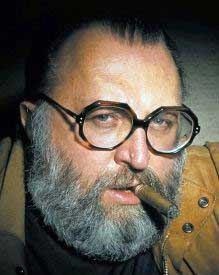
There are “transition” movies, and then there’s the almost comical embodiment of everything a “transition” movie could be. Duck, You Sucker! is the latter. Falling directly between Once Upon a Time in the West and Once Upon a Time in America, this is the film to watch if you need either a quick cliffs notes version of Leone’s entire output, or an unruly recap of one of the great one-classic-after-another directorial careers in history. Nearly every one of his thematic staples are on display here, and it’s almost a game in itself to identify those that reflect where he’s been and those that indicate where he’s going (yes, America was his last production, but there’s enough idiosyncratic material in that 229-minute monsterpiece for it to be considered the intellectual equivalent of at least four average movies). It may be telling that I was seriously tempted to begin this article with, “This movie is all that is good, all that is bad, and all that is ugly* about Sergio Leone’s wonderful, awe-inspiring body of work.” But if I did that, you might groan!
Perhaps not surprisingly, Duck, You Sucker! is not quite as formidable as most of Leone’s other works. While it certainly builds on the grandeur of The Good, the Bad and the Ugly and ...in the West—it’s one of the hugest movies I’ve seen, and absolutely underlines the fact that Leone was every bit Lean’s equal (and I’d sometimes say his superior, depending on which day of the week you ask me) in the visual scope department—it also finds the filmmaker working at a heretofore unseen level of self indulgence. Leone’s lowbrow, European brand of satiric comedy is all over the place in this film (and would pop up again in an even more unrestrained way in My Name is Nobody, which he produced and, as I understand it, sort of ghost directed), and Ennio Morricone’s music follows him right to the edge of the cliff. For many, the music might be too much-- follow this link, and listen to the sample of Track 10 on Disc 1. That’s right, the female voice is singing “Sean, Sean, Sean,” the name of James Coburn’s character. Imagine hearing this at least a dozen individual times throughout the film, and you’ll have some idea why half the audience I viewed this with twittered and laughed each time the theme returned.
Of course, both Leone and Morricone had been down this spaghetti western road so many times before that they’re probably entitled to a little genre-poking fun... but this approach poses problems for the film every time it aims to be taken seriously. When the scenes dealing directly with the Mexican revolution come around, you can almost feel Leone losing interest, chomping at the bit for something more universal and mythic. I don’t like to get into the “making-of” history in these articles, but in this case it’s worth pointing out that Leone wasn’t even initially going to direct this movie—he was going to produce it for Peter Bogdonavich. It’s strange to say, but for the first (and only, in my estimation) time in his post-Colossus of Rhodes career, Leone seems uninterested in his central premise. Indeed, I’ve just this moment read a quote by Leone in Christopher Frayling’s indispensable book Once a Time in Italy: The Westerns of Sergio Leone in which he stated, just before the production of this movie, that he’d “fallen out of love with the things associated with the West.” Well, sir... hate to say, but it kinda shows.
You see, boiled down, this is a film about political revolution that seems only very mildly interested in revolutionary concepts. For a film to be ambivalent about its own position on such an issue is fine, of course, provided it's going to really put some thought into it, but the way Leone deals with this is by too often retreating into comedy and genre familiarity. That the “genre” in question is one Leone himself created only compounds the problem. Rod Steiger’s performance as “Juan,” for instance, is such a big, over-blustery Eli Wallach impression that it's hard to see through to the sensitive work he contributes in some of the quieter scenes. (If you think about an "over-blustery Eli Wallach" hard enough, by the way, you might be able to understand why my companion at the screening said Steiger reminded him more than once of George Costanza).
Another example: Leone seems to believe that his classic bridge explosion scene in Good, the Bad was just an overture for the out-and-out symphony of “KA-BOOOM’s!!!” in this movie; a church, a mountain, a tree, another bridge, a train, a bank, a rock wall... There are some reviewers and fans that defend this somewhat schizophrenic approach as being Leone's comment on the smattering of politically-minded spaghetti westerns that had popped up in recent years past (The Big Gundown--which I'm so goddamn jealous Jeff GP is going to see and review sometime in the coming weeks, Run Man Run, A Bullet for the General, Campaneros, etc). I say, unless they're referring to "Hot Shots!," be very wary of anybody that says a movie is principally a "comment" about any other movie(s). The odds are pretty good that a person like that doesn't have any idea what they're talking about. Odds are equally good that they currently or will soon instruct a college course in film studies. Ha, ha! Take that, teachers!
Whoops! I’ve written all this, and failed to report that I really, really enjoyed the movie. When it’s able to side-step political concerns, it’s utterly splendid. The upside to Leone’s devil-may-care approach is that he’s willing to experiment even more than in Once Upon a Time in the West, and (as I intimated earlier) you can see Once Upon a Time in America’s central “guilt” storyline being born. Leone’s sense of revenge is also in good supply, and nobody does payback like this guy. In addition, Coburn is having a blast (yuk, yuk) playing an on-the-run, dynamite-toting IRA rebel, and the primary villain of the story drives around the desert in what can only be described as a giant Darth Vader helmet with machine guns for eyes (Leone loved his own brand of wacky machinery). It also represents the most "fuck's" I think I've ever heard in a supposedly PG-rated film.
In other words, for a Leone fan, the picture is completely essential. If it doesn’t quite approach the fun and adventure of The Good, the Bad and the Ugly, or the sweep and imagination of Once Upon a Time in the West, or the novelistic lyricism and heart of Once Upon a Time in America, then Duck, You Sucker! at least distinguishes itself as the single most "signature" picture of the man’s filmography; it's ambitious, rollicking, and endlessly entertaining. From one of the all-time masters of movies, that’s pretty damn good.
* “Ugly,” of course, standing in for a more appropriate adjective, like “fuckinglorious.”
 A Magnificent Obsession... with MURDER!
Jeff GP, NEW YORK CITYJanuary 25, 2007 - 35mm/Pioneer Theatre
With The Naked Kiss Samuel Fuller takes the domestic melodrama and injects a harsh bite of reality by infusing it with the urban emotional landscapes of his earlier noir. He relishes exposing unspeakable suburban perversion without condescension, in a way that should make the Todd Field’s and Alan Ball’s of the world cry themselves to sleep every night. A tiny twinge of what would make The Naked Kiss one of the best movies anyone has ever made can be felt in the Fuller-scripted Shockproof, directed by Douglas Sirk.
Douglas Sirk is no slouch of a moviemaker either, and the simple fact that this early collaboration of these soon to be legendary moviemakers exists should be indicative that, considering the guts of the content of their output, the pairing is not all that unlikely. On the surface, yes, Fuller is attributed to a certain run and gun, blood and guts hard-boiled type of junk movie, whereas next to “melodrama” (the word was practically invented for Sirk) the most common attribution of Sirk’s movies is “weepies.” Fuller’s movies, full of madness and nihilistic rage are often full of touching, subversive, politically progressive interpersonal behavior, whereas Sirk’s, caked in upper-middle class Technicolor, are filled with emotionally dry relationships that get turned upside down by scandal and a rage and helplessness below the bright, fancy dresses. The similarity between the two genres really come to a head in The Naked Kiss and Fuller firms himself as a far riskier director, but the suburban sentiment is the same.
A parole officer, Griff (a name Fuller would recycle for a crooked cop in The Naked Kiss), is assigned to keep tabs on a recently released murder, Jenny (Patricia Knight), who just so happens to be a leggy blonde knockout. Griff is a hard luck George Bailey type Good Samaritan caring for his blind mother and very young kid brother, while inviting parolees into his home for dinner. Despite his incredibly bland goodness, Griff (Cornel Wilde) carries a quiet desperation, nursing an oddly placed band-aid wrapped around his ring finger. Is it a bandage suggesting a previous heartbreak? Possibly.
Though at first she rejects it, Jenny eventually becomes swept up in the goodness and parolee and parole officer become husband and wife, but THEN! Bonnie and Clyde! The Honeymoon Killers! Jenny’s murderous streak strikes again, and her doting husband does everything to protect her, abandoning the comfort of suburban domesticity and his loving family. It would be easy to assume the rich Sam Fuller content kicks in hardcore with a murder, but this is where the movie starts to fall off the rails. The hard-nosed Jenny trading words with the well-intentioned citizens of this small town early on is where Fuller’s knack for dialogue shines. The melodrama hits hardest when the lovers are on the run as they struggle from meal to meal and toward the Mexican border. This is very typical genre material, with an added stroke of weepy drama yielding something a little north of boring, but lacking the life and vitality of the domestic scenes.
Shockproof is an oddity, as two not-yet young auteurs join forces in a movie that quite basely does combine what would come to define their careers. For fans of either, this is essential history, and considering the lack of availability of Fuller’s movies, a treasure for his fans, myself included. The boring bits are worth the always-priceless lyrical snap of Fuller dialogue, and while Fuller’s writing chops were established, Sirk’s direction is not what it would become.
dir. Robert Altman
 Muffin wears braces like a bird on a wire.
Jeff GP, NEW YORK CITYJanuary 22, 2007 - 35mm/IFC Center
A Wedding subscribes to the “let’s throw a bunch of shit at the wall and see what sticks” philosophy of Altmanic moviemaking. In this case the “bunchashit” are people and the “wall” is a lavish wedding party. The result is a dead grandmother of the groom, a sister of the bride pregnant with the groom’s child, some more deaths, an entire relationship arc of the “cheating” mother of the bride, Leonard Cohen covers, an old fashioned brotherly beating by the father of the groom and so on and so forth. A Wedding is, of course, a comedy, and a quite funny one. Wait, did somebody say a comedy with dead grandparent hijinks?! Where have we seen that before? Hmmm, possibly in National Lampoon’s Vacation or the uncomedy in the most serious movie ever made, The Grapes of Wrath? Nope, can’t think of anything else. I digress.
Somehow a movie with 48 speaking parts is able to go down easy and feel light, despite its reflective, serious moments. This is the big-budget action extravaganza (the Independence Day) of situation ensemble comedy. Like Gosford Park, the best of Altman’s “situation” movies (the only other being A Prairie Home Comapanion), there’s as much fun to be had with trying to keep characters straight as there is with the rich content. The most daunting task is following a flock of lovely redheaded ladies, many of whom are the spawn of mother of the bride, the very funny Carol Burnett. Her daffy country charm extends to her daughters; the bride (Muffin) is innocent and ignorant, whilst her sister (Buffy), played by Mia Farrow, acts the innocent country charm, but is quite the promiscuous girl. Ms. Farrow is something to behold, as she barely speaks a word and manages to steal most of her scenes with just a shrug.
On the male side there are many more redheads from both sides of the aisle including a rather large man who does his best to romance the married Ms. Burnett. Other than he and an Owen Wilsonish (wedding crasher!) college roommate of the groom, the men are far less interesting than the women. Luckily the women get the bulk of the attention as the mother and aunts of the groom scheme for the opportunity to tell everyone that their mother has died, but the men are mostly boring. Luckily, with 48 characters and chaos piled upon chaos, a little weakness only goes so far to be a minor annoyance.
A Wedding is regrettably underseen due to its lack of star power and being from that obscure post-Nashville pre-The Player portion of his career, when he continued making great movies. A Wedding makes a stellar pair with Nashville, acting as its less serious bridesmaid. Currently it is only available as part of a box set, but sometime soon it is due out on its own, hopefully with the incredibly informative (hopefully larger) movie poster.

Pan's Labyrinthdir. Guillermo del Toro
 Unfortunately for the Pale Man, he cannot cover his ears and use his eyes at the same time.
Spencer Owen, BERKELEYJanuary 26, 2007 - 35mm/Landmark Shattuck
There are, unsurprisingly, five movies nominated by the Academy for Best Score this year. One of them is Pan's Labyrinth, directed by the suddenly-beloved Guillermo del Toro. This movie is nominated in more than one category, which makes the fact of its recognition in the score department go down a bit smoother; if it had been nominated only in this category, I would be fairly perplexed, but now I can write it off as a sort of "associative" nomination. Y'know -- they thought it was a magical movie, and what's magic without magical music, or something. But really, what makes a score worthwhile enough to nominate?
I walked into Pan's Labyrinth ready to listen intently to the music -- no more intently than I normally hear music in films, that is, but with a particular attempt at Oscar-level acuity (note: sarcasm). Hearing with Academy ears, so to speak. I came out of the movie having enjoyed it on some levels and disliked it on others, the enjoyment only just edging out the dislike, as it has such wonderful imagery in the fantasy sequences and never quite gets truly boring or irritating in the rest... except for the matter of a particular musical concept. Yes, that's right; the music was my least favorite part, if only just for one lame idea, flaccidly executed. And I'm close-to-positive that this nauseating phrase was the reason why the music was nominated.
Javier Navarrete (this is the only work of his I've heard, due to his having scored primarily Spanish cinema I've never seen) does a suitable if thoroughly unimaginative job meeting the criteria of the styles. He does summon up some horror at moments meant to be horrific, notably to highlight the actions of the Pale Man, my favorite "character" in the movie. He does this nicely, and the visceral aspect takes it up a small notch. Still, 90%, even 95% of the movie is scored "suitably," rarely if ever transcending mere pragmatism or basic genre trope. This is not something I'd moan about if we weren't trying to figure out why it's 20% likely to win an Oscar. Is this all a movie needs to do to get the Academy's attention? Something's missing.
In fact, I believe they'd gotten through the entire first act before I heard any semblance of theme, and then it happened. The lead character, a girl named Ofelia, is going through some strife, no doubt. So is her foil and not mother but maternal substitute, Mercedes, who doesn't really get to know Ofelia but who nonetheless feels a deep bond with her, and who has a protective instinct and a strong moral backbone in general. Mercedes is cradling Ofelia in a time where they both could use a good cradling -- it's some emotional stuff, or at least it's meant to be -- and Ofelia asks Mercedes: "Do you know any lullabies?"
"Oh, this is it," I must have nearly said out loud, I thought it so clearly. Mercedes replies, "I don't remember the words, but..." With that, the score symphony actually pauses in order for her solo to begin, at which point she hums a quite insipid minor-key melody as the strings play the changes beneath her. I don't know where this melody came from -- a wholly original Javarrete composition, perhaps, or maybe an adaptation, maybe even from a real lullaby -- but if this is the moving motif we were waiting for, and oh it is, we are disappointed. It's a whiny sap-tap of a tune, something that would have worked much better if it hadn't been so obviously laden with significance. If she'd merely hummed the lullaby without the assistance of an orchestra and then we could move on, to speak of it later only as a humble scene... but no, this lullaby, of course! It's the emotional essence of the tale! How evocative this song is, how masterful its author for creating it just so!
And does it return? Mm. It haunts the rest of the movie, and I won't spoil too much, but it comes back at the end, twice as overwrought. Good thing you and Mr. Navarrete went to the John Williams seminar, Guillermo; that hour spent on Star Wars Episode II really made an impression. Bonus: plays over the credits, only a few minutes after it appears at the end, too! So here I wonder: who honestly cared for this enough to put it on a ballot? Was there nothing better? Could it really be just an "associative" nomination? In my favorite theoretical scenario, the head honchos who overwrite all the poll results were trying to think of a movie with a theme that Itzhak Perlman could play on stage at the ceremony without having to practice. You'll hear it a minimum of two more times, and one of those is guaranteed to be when it takes home Best Foreign Film; I hope the other one isn't when it wins Best Score.
Eraserheaddir. David Lynch
 Nance-y Boy.
Jeff GP, NEW YORK CITYJanuary 20, 2007 - 35mm/Museum of Modern Art
Eraserhead is a drill into my brain. Suck out some brains, mash it all up and stick on the end of a pencil. Life in a factory that makes pencils and sucks brains. It erases the pencil markings and narrative movie memories!
Eraserbed is the place Eraserhead takes me. Its woozy rumbling soundscapes and cloudy black and white dreamscapes are not the things of dream, but of sleep induction. That is, until…
Eraserbread is a bun in the oven. A giant leechy sperm, well-cooked and popped out; growing into a sickly horse fetus monster. Eraserbread is scary, boring, overcooked, overwrought, random, whiny, wide-eyed and underwhelming. David Lynch is insatiable. His immense cinematic appetite cannot simply be satisfied by this bouldery mountain of Eraserbread.
The uneven, bouldery, cavernous echo of Eraserhead is only matched by the molten, craggy, toxic gas spewing aggression of the chalkboard scratching Inland Empire. No matter what’s to be said of those two movies, no matter my slight distaste for Eraserhead and my staggering distaste for Inland Empire, David Lynch is some kind of monster when it comes to directing actors no matter the picture, and bless him for that, but somebody needs to keep him on a fucking leash, if only for a moment.
A monumental achievement for a young fellow, such as a young David Lynch, Eraserhead contains many wonderfully directed scenes of aggravating nonsense. With that said, any director so able to make any non-narrative stew shine with pure conviction of performance is a perfect match for a Hollywood picture. It almost makes Mr. Lynch the ideal director for hire, but then again his strengths are clearly guided by a wavering, yet rock solid certitude in his psyche. He’s the sidearm knuckleballer of cinema. He is quite the pitcher, no matter if he throws a ball or strike. Eraserhead is a stiff-haired sandlot Lynch practicing in his backyard, developing his style by throwing against the garage door. Inland Empire is Lynch inevitably throwing out his arm in Game 6 of the ’86 Series. Lynch, for a moment triumphing in epic stupendous disaster, becomes Bill Buckner. Whether or not this injury will be career-ending is left to be seen.
Back to that leash. The leash of a movie or television studio would bring upon Lynch’s greatest triumphs (The Elephant Man, Blue Velvet, Mulholland Dr., Twin Peaks). The 8-time Oscar nominee, The Elephant Man being the most typically narrative and oddly enough, his follow-up to Eraserhead. Like The Elephant Man, Eraserhead taps into the quite fear worthy subject of parenthood and deformity, both emotionally and physically. This physical viscera is what pushes bits of Eraserhead to greatness. The horse-headed pulpy mush of a child that the heroine, Mary (Charlotte Stewart), births is undoubtedly horrifying as well as a technical achievement. Is it a puppet? It must be a puppet, right? Whatever it is, its whine is a thing of death, and hero, Henry Spencer (Jack Nance) looks on in equal parts helpless befuddlement, adoration and anger. This look is now rightfully legendary and immortalized on merchandise.
If David Lynch can be blamed for anything specific in this world, it would not be merchandising, but the insistence film students and short-filmmakers have in feebly attempting to mimic the blown-out howl of the David Lynch emotional soundtrack. This howl is most effective when accompanied by any number of Lynch’s scores by composer Angelo Badalamenti. Eraserhead exists without his future collaborator, and the drone wears out its welcome.
The same goes for much of Eraserhead, as images repeat and reform themselves without the aid or comfort of character or precious narrative. Many of the images do stick. Lynch conjures his first of many riveting musical sequences and the image of a spectacular crystalline moon man. There are many seminal, classic bits of moviemaking here, and I will be forever grateful for the immense faith shown to Lynch post-Eraserhead, in order to make The Elephant Man and continue and build on what would become a career of legendary ups and downs, no matter how long we were forced to wait from one to the next. Do not make us wait anymore. Perhaps after Inland Empire you have another narrative masterwork in store for us, but I will not hold my breath, for that knuckleball may sink.